

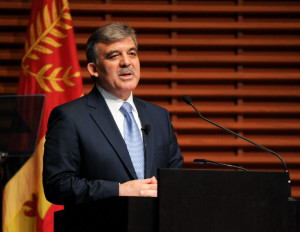
“Effective leaders must love to learn, change and expand,” said Abdullah Gul, president of Turkey, to a packed Cemex Auditorium Wednesday afternoon. “If you are not learning, maturing, changing or expanding, then you cannot expect the people to believe in you and follow you.”
Gul’s speech — titled “Leading Change by Reform, Commitment and Innovation: Reflections on Leadership by the President of Turkey” — was part of the Graduate School of Business’s (GSB) “View from the Top” lecture series, a student-run program that brings prominent figures to campus to share their insights on effective leadership.
Prior to being elected president in 2007, Gul served as Turkey’s foreign minister from 2003 to 2007 and prime minister from 2002 to 2003. He is a member of the Justice and Development Party in Turkey, a center-right party currently holding a strong majority of seats within Turkey’s parliament.
“The next decade is likely one where Turkey plays an increasingly important role bridging economic, geopolitical, cultural boundaries,” said GSB Dean Garth Saloner as he introduced Gul.
Gul focused his talk on leadership traits and skills, which he applied to examples from his own life ranging from his childhood in the town of Kayseri to his path to the presidency.
Kayseri is “renowned for its entrepreneurs,” according to Gul. However, he recalled that when he was a child, he failed to effectively market and sell his grandfather’s sodas.
“If that very failure would not have happened that day, most probably I would not be the president of the Turkish Republic today,” Gul said.
“Of course, had I been successful in selling sodas, I would be much richer now — a lot like most of my fellow Kayseri businessmen,” he added in jest.
Gul also discussed the eternal question of whether leadership ability is innate or acquired.
“Good leaders must, to be sure, also possess God-given traits,” Gul asserted. “However, I believe, in most cases, leadership is a nurtured phenomenon rather than a gift of nature.”
Gul emphasized other key leadership qualities in his talk, including the abilities to inspire, take decisive steps, adapt to a rapidly globalizing world and follow through on a clear vision.
Gul lauded progress in advancing democracy around the world — citing Egypt’s Tahrir Square protests and the Occupy movement — but criticized an alleged lack of bold decision-making by global leaders, particularly in Europe and the Middle East.
“The current situation in Europe is a telling example of how the lack of visionary leadership could adversely affect the lives of millions,” he said. “Another area where we witnessed a tragic failure of leadership is in the Middle East, where leaders have long been out of touch with their people.”
Drawing a connection between Stanford’s culture of innovation and ongoing regime change in the Middle East, Gul highlighted the importance of technology and social media in popular movements.
“Because of your innovations, no regime today has the luxury to govern its people behind iron curtains,” he said.
Gul also highlighted the need to be a risk-taking leader, citing his own visit to Armenia in September 2008 as an example of a time when he took an unconventional approach to the strained relations between Turkey and its neighbor.
“Risky as it was, I did the right thing by visiting Yerevan,” Gul said, denying any regrets about the visit. “If it is necessary, a good leader should also be able to make difficult decisions and painful concessions.”
Shifting his focus back to Turkey, Gul emphasized how reforms implemented at the turn of the century have positively benefited Turkey both politically and economically, emphasizing that Turkey remains the second fastest growing economy in the world behind China.
However, while Gul argued that, “Turkey today is more pluralistic, inclusive and tolerant than ever before,” he conceded, “we are under no such illusion that our task in improving democracy is over.”
In addition to democracy and human rights, Gul emphasized Turkey’s continuing objective of scientific and technological development, noting that Turkey has the fourth largest number of Facebook users globally.
“No nation, however self-sufficient or strong it may be, is capable of coping with the complexities of today’s world alone,” Gul said, stressing the need for strong collective, as well as individual, leadership.
Additionally, Gul emphasized the need for a leader to simultaneously adhere to his or her principles while embracing reality and opportunities. When presented, however, with conflicting choices, Gul emphasized, “my instinct always goes with the principle, and I will fight for principle to the end.”
He ended his speech by imparting leadership advice to assembled students.
“All I can leave with you today is the strong but simple advice that you never shy away from taking responsibility and that you lead when you can,” he said. “Graduating from Stanford, you will already be equipped with the necessary tools to succeed as leaders.”
Gul’s talk was followed by a question and answer session moderated by former Secretary of State — and current Stanford faculty member — Condoleezza Rice. Questions ranged from the Syrian crisis to Turkey’s rocky relations with Israel following Israel’s 2010 raid on a Gaza-bound aid ship in which nine Turks died.
“The Turkish people are majority Muslim and are free to practice what they believe,” Gul said in response to a question from Rice on the integration of Islam and democracy. “That’s why Turkey has become a source of inspiration for many countries in the Arab world.”